





Navigating the Challenges of AI Translation: Privacy, Bias, and the Importance of Human Oversight
The globalized economy operates at lightning speed, demanding rapid, seamless communication across dozens of linguistic and cultural borders. In response to this demand, the digital era has ushered in a wave of artificial intelligence tools that promise to break down language barriers instantly. From translating daily corporate emails to localizing massive e-commerce platforms, AI has undeniably accelerated the pace of global business.
However, as organizations increasingly rely on these highly advanced technologies, a new and complex set of issues has emerged. The rapid ethical evolution of AI demands that we look far beyond mere speed and convenience. Corporate leaders and localization managers must critically examine the AI Translation Challenges that threaten corporate integrity today. Specifically, we must address the severe, often hidden risks to Translation Data Privacy, the dangerous perpetuation of AI Bias in Language, and the gradual erosion of vital cultural nuances.
This article explores the ethical and operational hurdles of machine-generated language, why relying solely on public algorithms is a remarkably risky endeavor for modern businesses, and why Human Oversight in AI remains absolutely essential for delivering secure, high-quality, and Accurate Localization.
The Core Challenges of AI Translation
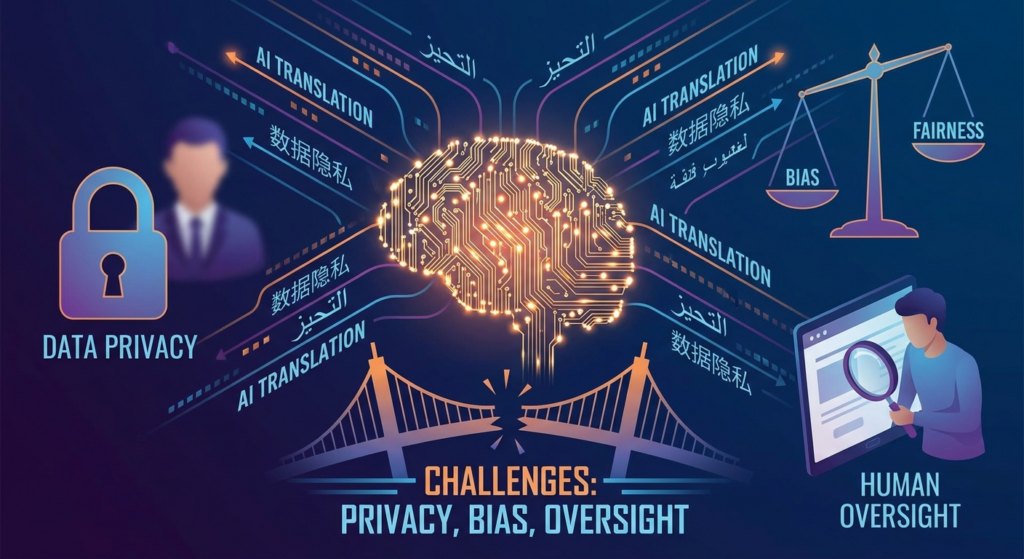
While artificial intelligence can process millions of words in a matter of seconds, it lacks the fundamental human traits of empathy, discretion, and cultural awareness. When businesses deploy AI without understanding its structural limitations, they open the door to significant vulnerabilities.
The Hidden Danger: Translation Data Privacy and Security
Perhaps the most critical, yet frequently overlooked, risk of utilizing free or publicly available AI translation tools is the threat to data security. When an employee drops a confidential legal contract, an unreleased product manual, or a sensitive internal memo into a public AI interface, what actually happens to that data?
For many popular artificial intelligence platforms, user inputs are actively harvested to further train their Large Language Models (LLMs). The moment you click “translate,” your proprietary data may become part of the machine’s permanent knowledge base. This creates a massive, systemic vulnerability regarding Translation Data Privacy.
If your organization is processing sensitive financial records, patient healthcare data, or proprietary software source code, using unsecured AI tools is functionally equivalent to leaving your confidential files on a public bench. There have been heavily documented instances where public generative AI engines inadvertently leaked sensitive corporate information to other users simply because the AI memorized and later regurgitated the training data.
For enterprise businesses, achieving a truly Confidential Translation process isn’t just an internal preference; it is a strict regulatory and legal requirement. Violating frameworks like the General Data Protection Regulation (GDPR) in Europe or the Health Insurance Portability and Accountability Act (HIPAA) in the United States through careless AI usage can result in catastrophic fines and irreparable brand damage.
Lost in Translation: AI Bias in Language
Beyond security, another profound challenge lies deep within the architecture of the algorithms themselves. AI models learn by ingesting vast datasets scraped from the internet. Because the internet is fundamentally flawed—and historically skewed toward certain dominant languages, cultures, and demographics—the AI inherently adopts these historical flaws. The result is the perpetuation of AI Bias in Language.
This inherent bias manifests in several highly problematic ways for global businesses:
- Gender Bias and Stereotyping: Many languages feature gendered nouns, adjectives, and pronouns. When translating from a structurally non-gendered language (such as Turkish or English) to a gendered one (such as Spanish, French, or German), AI often defaults to outdated, stereotypical gender roles. The machine might automatically assume that a “nurse” or “assistant” is female, while a “CEO” or “engineer” is male.
- Cultural Insensitivity and Blind Spots: Algorithms deeply struggle with idioms, humor, and localized cultural metaphors. A marketing slogan that is highly persuasive and colloquial in North America might be translated into something deeply offensive, culturally inappropriate, or entirely nonsensical in Japan or the Middle East. AI lacks the lived experience to recognize cultural taboos.
- Dialectical Erasure: AI models tend to heavily favor the dominant, most frequently published version of a language (e.g., standard Castilian Spanish over specific regional Latin American dialects, or Parisian French over Canadian French). This alienates local target audiences, makes the brand sound foreign or robotic, and fundamentally fails to deliver Accurate Localization.
Overcoming these systemic biases is the cornerstone of Ethical AI Translation. Machines merely understand the statistical probability of specific words appearing next to one another; they do not understand culture, historical context, or human empathy.
Why Public AI Tools Aren’t Enough for Enterprises
While a quick, free public AI translation might be acceptable for a tourist trying to read a restaurant menu, it falls critically short of the rigorous, high-stakes demands required by global enterprises. Enterprise Translation Solutions must navigate a highly complex web of brand voice consistency, strict regulatory compliance, and absolute data security.
Relying on public, unvetted AI tools exposes multinational companies to several severe risks:
- Reputational Damage: Publishing biased, poorly translated, or culturally tone-deaf content can alienate an entire market segment overnight, sparking public relations crises and destroying consumer trust.
- Legal Repercussions: Data leaks involving Personally Identifiable Information (PII) or protected corporate secrets violate stringent global privacy laws, exposing the company to lawsuits and compliance audits.
- Financial Loss: A poorly translated user manual for a piece of heavy machinery, or an inaccurate translation in a pharmaceutical dosage guide, can lead to catastrophic user errors, product recalls, and immense financial liabilities.
For businesses operating on a global scale, translation is not a commodity—it is a critical business function that requires enterprise-grade protection and precision.
The Imperative of Human Oversight in AI
If public AI tools pose such significant privacy and ethical risks, is the logical solution to abandon artificial intelligence altogether? Absolutely not. The future of the localization industry is not about forcing a choice between humans or machines; rather, it is about intelligently combining the raw processing power and scalability of AI with the irreplaceable expertise of the human mind.
This is precisely where Human Oversight in AI becomes non-negotiable.
Professional human linguists act as the ultimate safeguard and quality control mechanism in the modern translation workflow. This collaborative approach is often executed through a process known as Machine Translation Post-Editing (MTPE). In this workflow, secure AI performs the initial heavy lifting to generate a baseline translation, which is then followed by a rigorous, detailed review by human subject-matter experts.
Integrating human oversight ensures three critical outcomes:
- Contextual and Brand Accuracy: Human reviewers understand the overarching narrative, the specific target audience, and the purpose of a document. They massage the AI’s output to ensure the final translation perfectly aligns with the company’s unique tone of voice and brand guidelines.
- Active Bias Mitigation: Expert linguists are trained to actively spot and meticulously correct the gender, cultural, or historical biases that the AI inadvertently applies to the text. They ensure the language is inclusive, equitable, and respectful.
- Authentic Localization: True localization goes far beyond direct word-for-word translation. Humans adapt the content to the target market’s specific cultural expectations, local slang, currencies, measurement units, and societal norms—a level of nuanced adaptation that AI cannot reliably achieve on its own.
How Cube Localization Solves the Ethical AI Translation Puzzle
Understanding these profound AI Translation Challenges, Cube Localization has engineered a forward-thinking methodology that fully harnesses the speed and efficiency of AI while completely neutralizing its associated risks. Cube Localization provides premium, Secure Translation Services specifically designed for modern, global enterprises that flatly refuse to compromise on quality, ethics, or data security.
Here is exactly how Cube Localization overcomes the complex hurdles of privacy and algorithmic bias to deliver unparalleled results:
Closed-Loop, Enterprise-Grade Security
Unlike public translation engines that farm your data, Cube Localization utilizes private, closed-loop, enterprise-grade AI models. Your sensitive corporate data is never, under any circumstances, used to train public algorithms. Once your translation project is complete, your proprietary information remains entirely within a heavily encrypted, secure ecosystem. This stringent approach guarantees a completely Confidential Translation from start to finish, safeguarding your intellectual property and ensuring full compliance with global privacy regulations.
Verifiable Trust Through ISO Certifications
In the localization industry, trust must be built on verifiable, objective standards. Cube Localization operates under rigid information security policies backed by internationally recognized certifications. By providing an ISO Certified Translation process—specifically adhering to standards like ISO 27001 for Information Security Management and ISO 17100 for Translation Services—Cube Localization proves that their data handling, privacy protocols, and quality assurance workflows meet the absolute highest global standards.
Expert Human-in-the-Loop Methodology
Technology is only as good as the experts who wield it. Cube Localization employs a vast global network of highly vetted subject-matter experts and native-speaking linguists. These professionals provide the critical human oversight needed to ensure every single project is culturally neutral, highly precise, and completely free of AI Bias in Language. Whether translating complex legal statutes, technical engineering manuals, or nuanced marketing copy, Cube’s human experts ensure the final deliverable reads as authentically as if it were originally written in the target language.
A Steadfast Commitment to Ethical AI
Cube Localization views technology as a tool to empower human connection, not replace it. By actively monitoring AI outputs, utilizing bias-detection frameworks, and continuously refining their secure translation models, Cube Localization is a pioneer in Ethical AI Translation. They ensure that all localized content respects the diverse identities, values, and cultural nuances of global audiences, protecting your brand’s reputation across every border.
Conclusion
The rapid advancement of artificial intelligence is fundamentally transforming the language services industry, offering businesses unprecedented speed, cost-efficiency, and global scalability. However, as we have explored, the convenience of AI cannot come at the expense of corporate data security, legal compliance, or cultural respect. The risks of catastrophic data leaks and embarrassing linguistic bias are simply too severe for global businesses to ignore.
Achieving true global resonance and protecting your brand’s integrity requires significantly more than just a powerful algorithm. It demands a steadfast commitment to secure workflows, stringent data privacy protocols, and the deep, nuanced understanding that only professional human linguists can provide.
By partnering with an industry leader like Cube Localization—where Enterprise Translation Solutions are fortified by robust ISO certifications and expert human oversight—organizations can confidently navigate the ethical and operational complexities of the global market. You gain the remarkable speed of tomorrow’s technology, entirely safeguarded by the unparalleled precision and empathy of human expertise. Ultimately, this balanced approach ensures your message is protected, bias-free, and heard exactly as intended, everywhere in the world.