





The High Stakes of Legal Translation: Why AI Hallucinations are a Dealbreaker
In the legal world, words are not merely vehicles for ideas; they are legally binding instruments. A single misplaced comma, an incorrectly translated verb, or a misinterpreted technical term can change the entire scope of an agreement, invalidate a patent, or result in multi-million dollar litigation. Unlike casual translations, where a reader can easily infer meaning through context, legal translation operates in an environment of zero tolerance.
The rise of generative Artificial Intelligence (AI) and Large Language Models (LLMs) has revolutionized how businesses handle documentation. AI can summarize vast libraries of case law, draft template emails, and process hundreds of pages of text in seconds. However, the adoption of AI for raw legal translation has revealed a critical, structural vulnerability: AI hallucinations.
In daily life, a hallucination might be a harmless quirk of machine learning. In the legal sector, it is a catastrophic liability. To understand why AI translation is not yet ready to operate without human intervention—and why certified legal translators are more essential than ever—we must examine how machine learning handles language and the precise nature of legal risk.
The Phenomenon of AI Hallucinations: Confidently Wrong
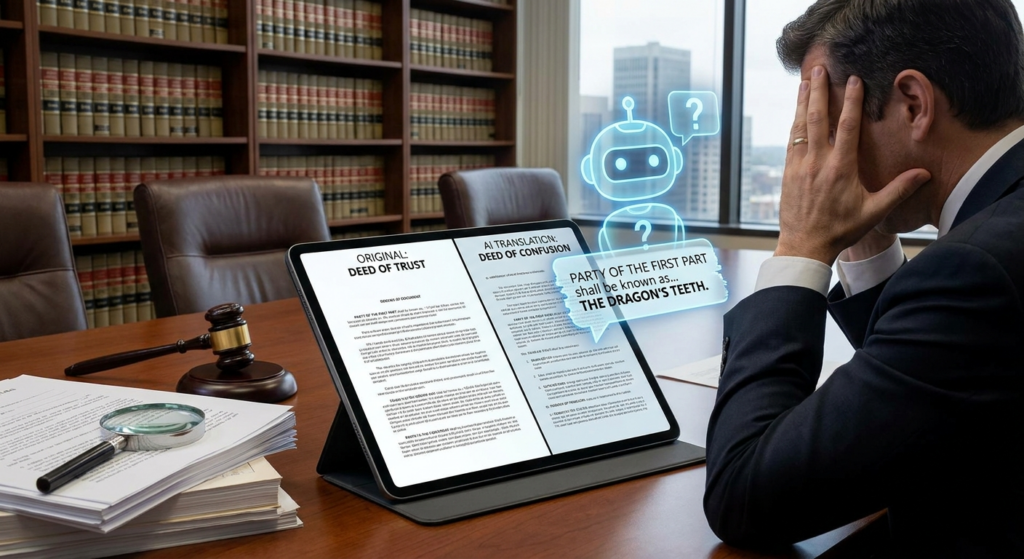
To understand why AI makes mistakes, one must understand how it processes language. LLMs do not “understand” legal systems, statutes, or contracts the way a human lawyer does. Instead, they are highly sophisticated prediction engines. They analyze massive datasets of text to calculate the mathematical probability of which word should follow the previous one.
An AI “hallucination” occurs when the model generates content that sounds incredibly fluent and plausible but is factually incorrect, legally ungrounded, or entirely fabricated.
Why AI Hallucinates in Legal Scenarios
- Probabilistic Guessing: When faced with highly specialized legal jargon that is underrepresented in its training data, the AI will still produce an output. It estimates the closest statistical match, resulting in terms that look professional but hold no legal validity in the target jurisdiction.
- Lack of Real-World Context: AI cannot cross-reference a translation with active regional statutes or dynamic treaty changes unless specifically instructed and trained on them in real-time. It operates within a static freeze-frame of its training data.
- Over-Generalization: AI struggles with structural differences between different legal systems—such as the conceptual divide between Common Law (precedent-based) and Civil Law (statute-based) jurisdictions. It often incorrectly maps concepts from one system onto another, creating non-existent legal duties.
In normal translations, if an AI translates “heavy rain” to “unprecedented downpour,” the essence remains intact. But if an AI translates a nuanced legal standard like “reasonable care” to an absolute standard of “guaranteed safety,” it opens the doors to massive liability.
Why Legal Precision Has a Zero-Tolerance Policy for Errors
The stakes in legal translation could not be higher. Here are the core areas where the margins for error are entirely non-existent:
1. Jurisdictional Discrepancies and Legal Equivalence
A primary challenge of legal translation is that laws are highly localized. There is rarely a direct, 1-to-1 conceptual equivalence between different languages and legal systems.
For instance, the French term force majeure has a highly specific meaning under French civil law, governed by established statutes and case laws. Simply translating it literally into English without understanding how English or American common law interprets “Acts of God” can lead to a contract that fails to protect a party in the event of an unexpected crisis. A specialized human translator knows when to translate the term literally, when to adapt it, and when to add a translator’s note to preserve the exact legal allocation of risk. AI simply lacks the conceptual capacity to manage these systemic divides.
2. The Nuance of Punctuation and Sentence Structure
Punctuation in legal documents dictates the distribution of liability, financial responsibility, and operational constraints.
Example of Ambiguous Modifiers:
"The provider shall not be liable for damage to goods, equipment, or machinery stored in the warehouse which occurs during the night."
If an AI translates this sentence into a language with strict gender and plural agreement rules (such as Spanish or French), it must decide what “which occurs during the night” applies to. Does it apply only to “machinery,” or to “goods, equipment, and machinery” as a collective group? A human legal translator will immediately spot this structural ambiguity in the source text, flag it to the client for clarification, and translate it in a way that eliminates ambiguity. AI will make a probabilistic guess, choosing one interpretation over another without warning either party of the hidden assumption.
The Illusion of Fluency: Why AI Deceives Even the Experts
The most dangerous aspect of AI translation is its fluency. Traditional machine translation (like early Google Translate) produced disjointed, obviously broken sentences that immediately signaled to a reader that the translation was unreliable.
Modern generative AI produces beautiful, grammatically flawless prose. It reads like it was written by a native legal professional. This is what experts call a fluent error. Because the prose is so smooth, human reviewers naturally lower their guard, making it incredibly difficult to spot deep structural mistakes, missing clauses, or reversed meanings (such as translating “not liable” as “liable” due to a syntax omission).
| Translation Type | Visual indicators of Error | Risk Level | Detection Rate |
|---|---|---|---|
| Traditional Machine Translation | High (Broken grammar, literal phrasing) | Medium | Very Easy |
| Generative AI (Raw) | Extremely Low (Reads fluently, elegant vocabulary) | Critical | Extremely Hard |
| Certified Human Translation | Minimal (Maintains structural integrity and accurate terminology) | Negligible | High Quality Guaranteed |
Real-World Consequences of AI Translation Failures
Using raw AI translations without strict human validation can result in a cascade of commercial, regulatory, and legal problems:
- Voided Contracts: An inaccurate translation of a governing law clause or arbitration clause can render a contract unenforceable in a foreign jurisdiction, leaving businesses without legal recourse.
- Loss of Intellectual Property (IP): Patent applications require absolute scientific and legal accuracy. If an AI misrepresents a chemical compound name or a mechanical engineering term during translation, the patent could be rejected, or worse, approved with a loophole that allows competitors to steal the design.
- Regulatory Compliance Failures: Global companies must comply with regional standards like the GDPR, HIPAA, or local anti-money laundering (AML) laws. A mistranslation of compliance guidelines can lead to regulatory audits, operational shutdowns, and massive financial penalties.
- Impaired Mergers and Acquisitions (M&A): During due diligence, millions of pages of documents must be evaluated. If translated key financial liabilities or litigation histories are distorted by AI, companies can end up acquiring massive, unforeseen debts.
Why Certified Human Linguists Are Irreplaceable
To eliminate the risks of AI hallucinations and ensure legal validity, certified human legal linguists remain indispensable.
Human Translators Translate Systems, Not Just Words
A qualified legal translator is not just someone who speaks two languages. They are subject-matter experts who frequently hold degrees in both law and translation. They understand the legislative systems of both the source and target countries. They recognize the hidden traps of terminology, context, and legal style.
Intellectual Responsibility and Accountability
If an AI translates a document incorrectly and a company suffers a multi-million dollar loss, there is no legal recourse against the AI model. With certified human translation, you work with professional translation partners who assume legal responsibility. They provide certificates of accuracy that are accepted by courts, government agencies, and regulatory bodies worldwide.
Ethical Safeguards and Data Confidentiality
When sensitive legal documents (such as pending patents, litigation strategies, or employee records) are inputted into public AI tools, there is a severe risk of data leakage. Many AI engines use user queries to train future iterations of their models, meaning confidential corporate data could be exposed. Professional translation agencies employ secure, closed-loop systems and strictly adhere to non-disclosure agreements (NDAs) to protect sensitive information.
Cube Localization: Zero Tolerance for Errors, Total Protection for Your Business
In the legal industry, navigating international transactions, foreign litigations, and multi-jurisdictional compliance leaves no room for experimentation. At Cube Localization, we understand that legal translation requires absolute accuracy, total confidentiality, and zero tolerance for error.
We do not let algorithms determine your legal liabilities. Our processes rely on specialized legal translators who possess deep knowledge of international law, regional frameworks, and local jurisdictions. Whether you are translating complex commercial contracts, cross-border patent applications, or crucial compliance documentation, our teams ensure every single word is legally sound, meticulously translated, and fully context-equivalent.
With Cube Localization as your trusted partner, you safeguard your organization against the hidden traps of machine-generated inaccuracies. We blend advanced translation project management tools with the unmatched precision of certified, human-led linguistic experts.
Conclusion: Balancing Efficiency with Safety
Artificial intelligence is an extraordinary tool for research, brainstorming, and high-speed document sorting. However, using it blindly to execute final-draft legal translations is a high-risk gamble that no enterprise should take.
In law, language is power, responsibility, and protection. AI hallucinations are an unacceptable dealbreaker when your assets, intellectual property, and corporate reputation are on the line. Ensuring that your translations are completed, reviewed, and certified by experienced human linguists is not an unnecessary expense—it is an essential compliance mechanism. Rely on the human legal experts at Cube Localization to ensure your international endeavors are legally airtight and built for global success.