





AI and the Human Translator: Integration or Replacement?
Artificial intelligence has seamlessly woven itself into the fabric of almost every modern industry, fundamentally altering how we work, communicate, and create. In the realm of global communications, the intersection of AI and translation has sparked a heated, ongoing debate. As neural networks become increasingly sophisticated at processing language, a common misconception has taken root: the idea that AI will completely replace human translators.
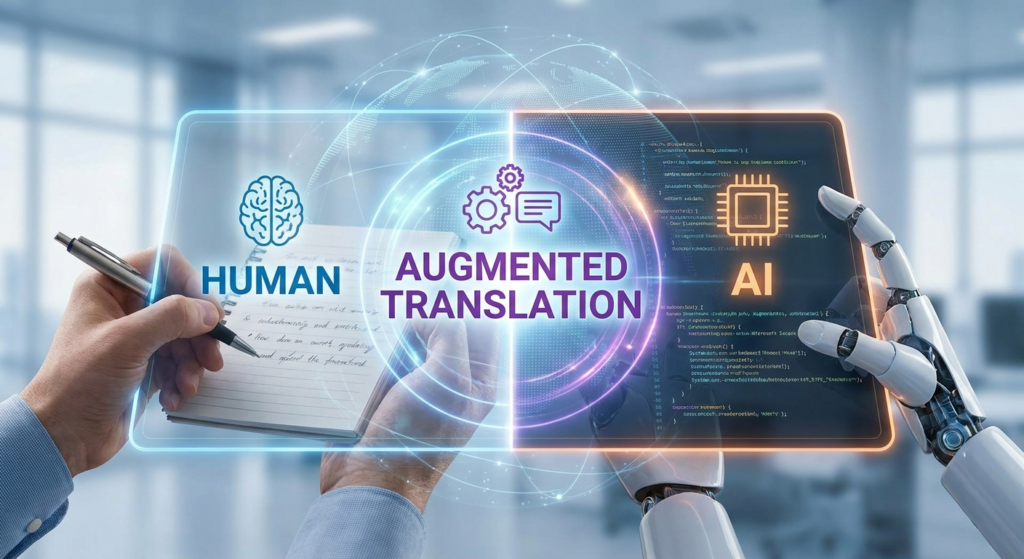
However, this binary view of the future completely misses the reality of how language works. The dynamic between technology and language professionals is not a zero-sum game. Instead of a hostile takeover, the most dominant translation industry trends point toward a collaborative future. This powerful synergy is known as “Augmented Translation,” a process where AI tools act as high-speed assistants, while the human mind intervenes to inject cultural nuances, emotional resonance, and complex contextual understanding.
In this article, we will explore the ongoing “Human vs AI Translation” debate, debunk the myth of the obsolete translator, and highlight how industry leaders like Cube Localization successfully merge the raw power of modern technology with deep human expertise.
The Evolution of AI Translation Tools
To understand where the translation industry is heading, we must first look at how far it has come. Early machine translation systems were rule-based, relying on rigid dictionaries and grammatical frameworks. They produced clunky, often comical translations that failed to capture the basic flow of human speech.
The introduction of Neural Machine Translation (NMT) changed the landscape entirely. Modern AI translation tools use deep learning models to analyze vast amounts of bilingual data. They can predict word sequences, recognize patterns, and produce highly readable text in a fraction of a second. This exponential leap in quality is what initially fueled the fear that human linguists would soon be out of a job.
Yet, as businesses began to rely heavily on these automated systems for global expansion, the cracks in the armor became evident. While AI can process millions of words per minute, it fundamentally lacks the lived human experience required to understand why we say what we say. It processes data, but it does not understand context.
Demystifying the Myth: Why AI Won’t Replace Human Linguists
The idea that AI will render human translators obsolete stems from a fundamental misunderstanding of what translation actually entails. Translation is not merely the substitution of a word in one language for a corresponding word in another. It is a highly complex cognitive process that requires empathy, cultural awareness, and creativity. Here is why human linguists remain absolutely indispensable.
The Limitation of Literal Translation
AI translation tools operate on probability. They select the most statistically likely translation based on their training data. While this works beautifully for straightforward technical manuals or financial reports, it falls apart when confronted with ambiguity, idioms, or humor. A human translator understands that translating “it’s raining cats and dogs” literally into Spanish or Japanese will only confuse the reader. Human linguists possess the cognitive flexibility to identify idiomatic expressions and find the equivalent idiom in the target language, ensuring the core message remains intact.
Empathy, Emotion, and Creative Translation
Marketing copy, brand narratives, literature, and user interfaces are all designed to evoke a specific emotional response from the audience. A skilled translator practices creative translation (or transcreation) to capture the brand’s voice and emotional undertone. AI cannot feel empathy; it cannot sense the subtle shift in tone between a playful marketing slogan and a serious corporate manifesto. Human translators rewrite and adapt content so that it resonates emotionally with the target audience, an essential component for any brand looking to build trust in a new market.
The Vital Role of Cultural Adaptation
Language and culture are inextricably linked. What is considered persuasive and polite in one culture might be perceived as aggressive or inappropriate in another. Cultural adaptation involves tailoring content to align with local customs, societal norms, and cultural sensitivities. Human linguists draw upon their deep, culturally embedded knowledge to navigate these landmines. They know when to alter a pop-culture reference, adjust formatting, or soften a localized message. AI, devoid of cultural consciousness, simply cannot perform this critical function.
The Rise of Augmented Translation
If AI is not replacing humans, what exactly is happening? The answer lies in “Augmented Translation.” This is arguably the most significant of all current translation industry trends.
Augmented translation represents a paradigm shift from a competitive mindset to a collaborative one. In this model, AI is viewed as an “exoskeleton” for the human mind. It handles the repetitive, heavy lifting—processing the bulk of the text, managing terminology databases, and providing instant first-draft translations.
This technological foundation frees up human linguists to focus on what they do best: the art of language. By automating the tedious aspects of the job, translators can dedicate their mental energy to refining the text, adjusting the tone, and ensuring flawless cultural adaptation.
The benefits of Augmented Translation are manifold:
- Unprecedented Speed: AI can generate a preliminary translation of a massive document in seconds, drastically reducing overall turnaround times.
- Cost-Efficiency: Because the human translator is editing rather than translating from scratch, localization budgets can be optimized and stretched further.
- Enhanced Consistency: AI translation tools can seamlessly integrate with Translation Memory ™ and glossaries, ensuring that highly specific industry terminology remains consistent across hundreds of pages.
- Elevated Quality: With the initial draft taken care of, human linguists can elevate the text from “understandable” to “engaging and natural.”
Machine Translation Post-Editing (MTPE Services): The Golden Mean
The practical application of Augmented Translation is most commonly seen in Machine Translation Post-Editing (MTPE). As global content demands skyrocket, MTPE services have become the golden mean for businesses that need high-volume translations without sacrificing quality.
MTPE involves feeding the source text into a highly trained neural machine translation engine. Once the AI generates the initial output, a professional human linguist steps in to edit, refine, and polish the text. There are generally two levels of MTPE services:
- Light Post-Editing (LPE): The human linguist reviews the AI-generated text strictly for accuracy and comprehensibility. The goal is to ensure there are no glaring errors, mistranslations, or offensive terms. The final text might not sound beautifully stylized, but it is accurate and serves its purpose. This is ideal for internal communications, raw data, or massive product catalogs.
- Full Post-Editing (FPE): The linguist thoroughly reworks the AI output to ensure it sounds entirely natural, as if it were originally written in the target language. The focus here is on style, tone, cultural adaptation, and creative translation. Full MTPE is essential for customer-facing content, marketing materials, and user interfaces.
Through MTPE services, brands no longer have to choose between the speed of a machine and the quality of a human. They get the absolute best of both worlds.
How Cube Localization Harmonizes AI and Human Expertise
Navigating the intersection of AI and translation requires more than just buying software; it requires a sophisticated, tested methodology. At Cube Localization, the “Human vs AI Translation” debate has been settled through a perfectly balanced ecosystem that champions human intelligence empowered by cutting-edge technology.
Cube Localization understands that raw technological power is useless without the guiding hand of deep human expertise. To deliver content that is natural, engaging, and culturally resonant, Cube Localization employs a highly refined Augmented Translation workflow:
- Customized AI Engines: Cube Localization does not rely on generic, one-size-fits-all machine translation. They utilize specialized AI engines that are trained on industry-specific data, ensuring a higher quality baseline tailored to the client’s specific niche—whether that is legal, medical, or technical.
- Expert Human Linguists: Technology is only as good as the people wielding it. Cube Localization pairs their advanced AI output with native-speaking, subject-matter experts. These linguists don’t just proofread; they breathe life into the text. They intervene to adjust cultural nuances, inject appropriate emotions, and untangle complex terminologies that the AI may have misinterpreted.
- Rigorous Quality Assurance: The harmonization of AI and human effort is backed by an uncompromising quality assurance process. Human reviewers assess the final output to ensure absolute cultural adaptation and brand alignment, guaranteeing that the final message lands perfectly with the target audience.
By successfully merging AI speed with human soul, Cube Localization provides a localization service that meets the aggressive timelines of the modern business world without ever compromising the integrity and cultural resonance of the content.
Conclusion
The narrative that artificial intelligence will lead to the extinction of the human translator is a myth. While AI translation tools have undoubtedly revolutionized the speed and scale at which we process language, they remain tools—highly advanced calculators of language that lack the empathy, cultural depth, and creative spark intrinsic to the human experience.
The future of global communication lies in Augmented Translation. Through sophisticated MTPE services, the industry has found a way to let machines do the heavy lifting while humans provide the soul. Companies like Cube Localization prove that when you integrate the raw power of AI with the nuanced brilliance of human linguists, the result is fast, cost-effective, and deeply resonant communication. In the end, AI will not replace translators; but translators who leverage AI will undoubtedly replace those who do not.