





Localization 101: How to Measure Your Localization ROI: Costs, Benefits, and KPIs
Expanding your business into international markets is an exciting milestone. Whether you are launching a SaaS platform in Germany, selling e-commerce products in Japan, or offering digital services in Brazil, breaking past geographical boundaries opens the door to massive growth. However, this growth requires adapting your product, marketing, and support channels to local audiences—a process known as localization.
For many businesses, localization can feel like a heavy expense. Translations, technology, and project management quickly add up. To justify this investment to stakeholders and ensure your global strategy is actually working, you need to understand how to measure your Localization Return on Investment (ROI).
Measuring localization ROI involves tracking specific Key Performance Indicators (KPIs), understanding your upfront and ongoing costs, and quantifying the direct and indirect benefits of a localized experience. Here is everything you need to know to move localization from a perceived “cost center” to a proven revenue driver.
Understanding Localization ROI
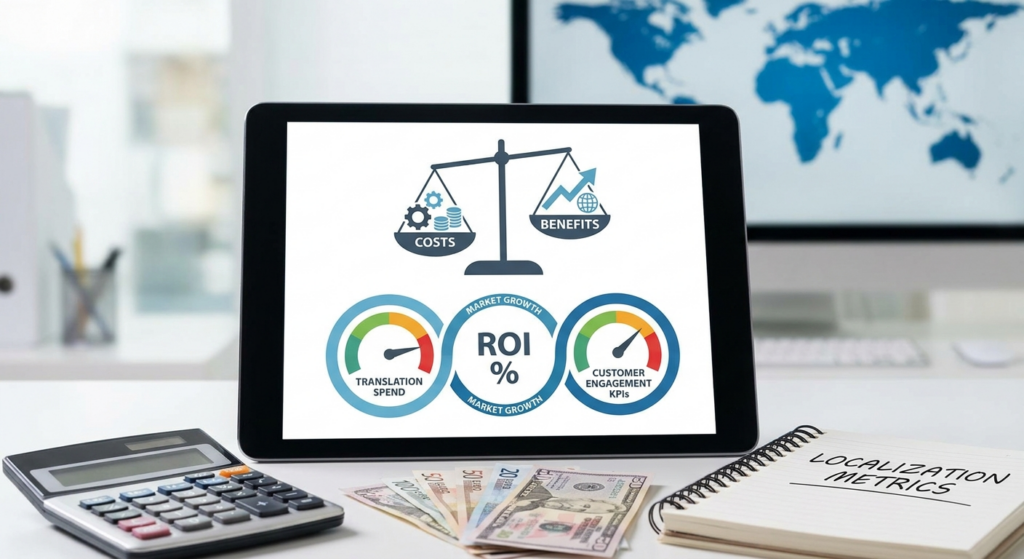
At its core, Return on Investment is a straightforward financial metric used to evaluate the profitability of an investment. The standard formula is:
ROI = [(Financial Value of Investment – Cost of Investment) / Cost of Investment] x 100
While the math is simple, plugging the right numbers into this formula for localization can be incredibly complex. How do you measure the exact revenue generated by translating a checkout page? How do you quantify the money saved by translating a help center? To calculate an accurate ROI, you must break down the specific costs involved and meticulously track the benefits through targeted metrics.
The Costs of Localization (The Investment)
To determine your total localization investment, you have to look beyond the basic cost of translation. True localization requires a comprehensive strategy encompassing technology, human capital, and ongoing maintenance.
1. Direct Translation and Localization Costs
This is the most obvious expense. It includes the fees paid to Language Service Providers (LSPs), freelance translators, editors, and proofreaders. Depending on your model, this may be calculated per word, per hour, or via retainer. Direct costs also include the creation of localization assets like glossaries and style guides.
2. Technology and Infrastructure
You cannot manage a global operation efficiently through spreadsheets and email attachments. Most companies invest in:
- Translation Management Systems (TMS): Software platforms that automate workflows, manage translation memories, and facilitate collaboration.
- Connectors and APIs: Tools that connect your TMS directly to your Content Management System (CMS), code repositories (like GitHub), or design software (like Figma).
- Machine Translation (MT) Engines: Subscriptions to advanced AI or neural machine translation tools that pre-translate content to lower human localization costs.
3. Human Capital and Project Management
Your internal team will spend significant time managing the localization pipeline. You must account for the salaries and hourly wages of internal project managers, developers who integrate translated text into the UI (User Interface), and regional managers who perform Linguistic Quality Assurance (LQA) to ensure the translations hit the right tone.
4. Ongoing Maintenance
Localization is not a one-and-done project. Every time you push a new product update, publish a new blog post, or update your pricing page, those updates must be localized. This recurring maintenance is an integral part of your long-term localization cost.
The Benefits of Localization (The Return)
To calculate ROI, you must understand the financial value localization brings to the table. Some returns are immediate and direct, while others build up over time.
1. Revenue Growth and Increased Market Share
The primary reason companies localize is to unlock new revenue. Research consistently shows that a vast majority of consumers—over 70%—prefer to buy products in their native language, and many refuse to buy from sites that are English-only. By localizing, you tap into entirely new customer bases, driving international sales, subscription sign-ups, and long-term contracts.
2. Higher Conversion Rates
A user may find your English website and understand it well enough to browse, but when it comes time to enter credit card details, trust is paramount. Localizing the checkout process, translating product descriptions, and displaying prices in the local currency dramatically reduce cart abandonment and increase conversion rates.
3. Reduced Customer Support Costs
If an international user cannot figure out how to use your software because the UI is not in their language, they will submit a support ticket. Support tickets are expensive to resolve. By localizing your product, knowledge base, FAQs, and chatbot, you empower users to self-serve, which drastically reduces the burden on your customer support team.
4. Enhanced Global SEO
Translating your website is one of the most effective ways to generate international organic traffic. A strong localized SEO strategy ensures that your website appears on local search engines (like Google in Europe, Baidu in China, or Naver in South Korea) when users search for your product category in their native language.
Key Performance Indicators (KPIs) to Track
To translate the benefits above into quantifiable data, you must establish clear KPIs before you launch into a new market. By benchmarking these metrics before and after localization, you can see the direct impact of your investment.
Financial and Sales KPIs
These are the metrics your CFO cares about the most. They tie directly back to the revenue side of your ROI calculation.
- Revenue by Locale/Language: Track the gross revenue coming from specific target markets.
- Conversion Rate by Language: Compare the percentage of visitors who complete a purchase on your localized site versus the baseline English site.
- Average Order Value (AOV): Monitor if international buyers are spending more per transaction now that they fully understand your offerings.
- Customer Acquisition Cost (CAC) by Market: Does localizing your marketing ads and landing pages make it cheaper to acquire a customer in Germany or France?
Marketing and Engagement KPIs
Engagement metrics reveal how well your localized content is resonating with international audiences.
- Organic Traffic Growth: Measure the month-over-month increase in visitors coming from search engines in targeted countries.
- Bounce Rate: If your localized website accurately reflects the cultural and linguistic expectations of a region, users will stay longer. A drop in bounce rate is a strong indicator of successful localization.
- Time on Page / Session Duration: If visitors spend significantly more time on localized product pages compared to unlocalized ones, they are reading and engaging with the content.
Customer Success KPIs
Happy customers stay longer and spend more. Tracking support metrics helps quantify the money saved by localization.
- Support Ticket Volume by Language: Measure if translating the Help Center decreases the number of incoming tickets from a specific region.
- Customer Satisfaction Score (CSAT): Survey users on their experience. A localized product usually yields higher CSAT scores than an unlocalized one.
- Net Promoter Score (NPS): Discover if international users are more likely to recommend your product once it is available in their native language.
Operational KPIs
Operational metrics help you optimize your internal processes, ultimately driving down the cost of the investment in the ROI formula.
- Time-to-Market: How quickly can you translate and launch a new feature?
- Cost per Word: Keep track of how much you are spending on raw translation. Leveraging translation memories over time should lower this metric.
- Linguistic Quality Assurance (LQA) Score: Tracking the number of errors or revisions required during translation review helps gauge vendor quality.
Step-by-Step Example: Calculating Localization ROI
Let’s look at a practical, simplified example to see how these metrics and costs come together.
The Scenario: A B2B software company based in the US decides to localize its website and core software platform into Spanish to capture the Latin American (LATAM) market.
Step 1: Determine the Costs
Over the course of a year, the company spends:
- TMS Software Subscription: $10,000
- LSP Vendor Fees (Translation & Review): $40,000
- Internal Project Management (Calculated via hourly wages): $15,000
- Total Investment = $65,000
Step 2: Determine the Financial Benefit
To figure out the revenue gained strictly from this localization effort, the company measures its baseline revenue in LATAM prior to localization and compares it to the revenue one year post-launch.
- Year 0 LATAM Revenue (Unlocalized): $100,000
- Year 1 LATAM Revenue (Localized): $300,000
- The company also notes a $20,000 reduction in Spanish customer support costs because they translated the knowledge base.
- Total Financial Benefit = $200,000 (New Revenue) + $20,000 (Saved Costs) = $220,000.
Step 3: Calculate the ROI
Now, apply the ROI formula: [(Financial Value – Cost) / Cost] x 100
- ROI = [($220,000 – $65,000) / $65,000] x 100
- ROI = [$155,000 / $65,000] x 100
- ROI = 238%
In this scenario, for every dollar the company spent on Spanish localization, they gained their initial dollar back plus an additional $2.38 in profit. This creates a compelling, data-backed argument for expanding localization efforts into French, German, or Japanese next.
Best Practices for Measuring ROI Accurately
To ensure your numbers are grounded in reality, keep a few best practices in mind:
- Establish Baselines Early: You cannot measure growth if you don’t know where you started. Document your traffic, revenue, and support ticket volumes for target regions at least three months prior to localizing.
- Be Patient: While conversion rates on checkout pages might jump immediately, Global SEO takes time to index and rank. Don’t pull an ROI report at week two and declare the project a failure; give it at least three to six months to mature.
- Use Cohort Analysis: Track user behavior based on the language they select. Compare the Customer Lifetime Value (CLV) of an English-language user in Europe against a native-language user in Europe.
- Factor in Translation Memory Savings: As your localization program matures, your software will memorize previously translated sentences. Make sure to account for this lowered cost per word in your long-term ROI calculations.
Conclusion
Measuring localization ROI does not have to be an abstract guessing game. While localization requires a clear upfront investment in technology, human capital, and language services, the resulting expansion in global reach almost always justifies the cost. By treating localization as a strategic growth lever rather than a simple translation exercise, and by rigorously tracking KPIs ranging from conversion rates to reduced support tickets, you can clearly map the direct financial benefits of your global strategy. Start with clear baselines, calculate your metrics diligently, and use your ROI data to scale confidently into new international markets.