





Most Localization Teams Aren’t Ready for AI Workflows: Bridging the Gap
The artificial intelligence revolution has officially arrived at the doorstep of the language industry. Powered by Large Language Models (LLMs) and advanced Generative AI, the promise is highly enticing: unprecedented translation speeds, real-time contextual adaptation, and a drastic reduction in localization costs. From the C-suite down, the directive is increasingly clear: Implement AI to scale our global reach.
However, beneath the surface of this corporate enthusiasm lies a stark reality. Despite the rapid advancement of AI technology, the overwhelming majority of localization teams are not ready for AI workflows.
Integrating AI into localization is not as simple as flipping a switch or connecting an API. It requires a fundamental paradigm shift in how we think about translation management, human talent, quality assurance, and pricing. Let’s explore the underlying reasons behind this localization gap and outline actionable strategies to bridge it.
The AI Illusion in Localization
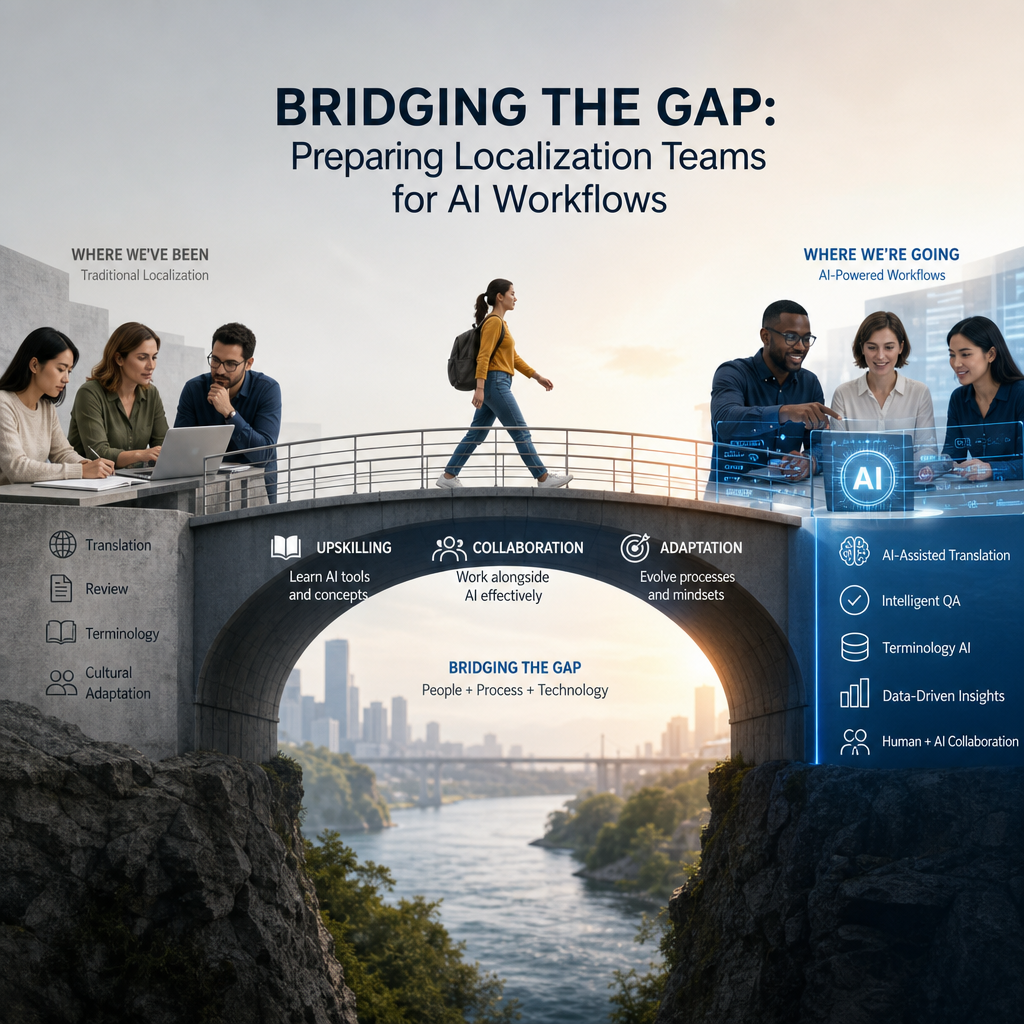
For over a decade, localization teams have relied on Neural Machine Translation (NMT) platforms. NMT engines, while incredibly useful, are fundamentally deterministic. They take a string of text in one language and output a highly probable string of text in another. Traditional Translation Management Systems (TMS) and Computer-Assisted Translation (CAT) tools were perfectly designed to incorporate this linear process into the standard Translation, Editing, and Proofreading (TEP) workflow.
Generative AI fundamentally changes this dynamic. Tools powered by LLMs do not just translate; they write, rewrite, format, summarize, and adapt text based on fluid, nuanced prompts.
Many business leaders fall into the “plug-and-play illusion.” They assume that because tools like ChatGPT can produce an impressively accurate Spanish translation of a marketing email in five seconds, they can simply plug an LLM into their existing workflow and replace human translators entirely. What they fail to realize is that without strict workflow controls, custom prompt engineering, and modern quality assurance loops, AI introduces an entirely new set of problems: tone inconsistencies, brand voice deviation, and dangerous contextual hallucinations.
Why Most Localization Teams Are Falling Behind
The gap between AI’s potential and actual implementation is wide. Most localization teams find themselves struggling to adopt these technologies due to a combination of legacy systems, skill shortages, and outdated processes.
Legacy Infrastructure and Tooling
The technology stack utilized by most localization departments was built for a different era. Traditional CAT tools segment content string-by-string. A human translator translates sentence A, then sentence B, completely divorced from the visual layout of the final product.
LLMs, however, thrive on holistic context. To generate the best localized output, an AI model needs to “see” the entire document, understand the brand guidelines, and reference a specific persona. When traditional systems force LLMs to translate segmented, isolated strings via API, they essentially rob the AI of its superpower: contextual awareness. Bridging the gap requires a technological pivot toward platforms capable of feeding dynamic, document-level context to AI engines.
The Linguistic Skill Gap
For decades, localization professionals have trained to be expert linguists and meticulous editors. The rise of Machine Translation introduced “Post-Editing” (MTPE), teaching linguists to correct machine errors. AI requires a totally different interaction model.
Tomorrow’s localization professionals must become AI Directors or Prompt Engineers. Rather than fixing localized text after it has been generated, they need to know how to set the parameters before the generation happens. This requires an understanding of how to craft few-shot prompts, inject tone-of-voice variables, and tweak temperature settings in AI models. Most localization teams currently lack the training programs necessary to pivot their linguists from traditional translators to advanced AI operators.
Outdated Quality Assurance Frameworks
Standard localization Quality Assurance (QA) metrics are built to catch human errors or rigid machine translation errors: typos, missing tags, grammatical mistakes, and direct glossary violations.
AI-generated text behaves differently. An LLM rarely makes basic grammatical errors. Instead, its localized output reads incredibly fluently—even when it is completely wrong. This is the danger of the AI “hallucination.” Furthermore, AI can subtly shift the tone of a document, making a formal technical manual sound slightly too conversational. Traditional Language Quality Assurance (LQA) models struggle to systematically catch, categorize, and penalize these fluid, AI-specific errors.
The Breaking Point of Per-Word Pricing
Since the dawn of the commercial localization industry, the standard metric for compensation has been the “per-word” rate. A translator is paid per word translated; a post-editor is paid a fraction of a per-word rate to edit machine output.
AI shatters this economic model. If an AI translates a 10,000-word website, and a human linguist spends three hours carefully engineering the prompt, refining the glossary integration, and reviewing the output for brand consistency, how do you pay them? A fractional per-word rate vastly undercompensates them for their technical expertise, while a standard rate erases the cost-saving benefits of AI. The localization industry has yet to broadly adopt the hourly, value-based, or subscription-based compensation models necessary to support AI-driven human-in-the-loop workflows.
Bridging the Gap: A Blueprint for AI Readiness
The shift toward GenAI in localization is not a passing trend; it is the new baseline. Localization managers, operations teams, and Language Service Providers (LSPs) must proactively build the bridge to AI readiness. Here is a practical blueprint for getting your team up to speed.
1. Upgrade to Context-Rich Tech Stacks
Move away from tools that enforce strict, sentence-by-sentence translation limits. To bridge the technology gap, begin migrating to continuous localization platforms that support document-level and context-aware LLM integrations.
Look for tools that allow you to append dynamic “context windows.” When sending a batch of content to an LLM, the system should automatically inject your brand style guide, a specific localized glossary, and a description of the target audience into the prompt. Modern AI workflows succeed only when the AI has the same project brief a human translator would receive.
2. Implement the “Human-in-the-Loop” (HITL) 2.0
Instead of pushing linguists out, invite them earlier into the process. The new workflow shouldn’t be AI generates → Human fixes. It should be:
- Context Setup: Human linguist curates the glossary, style guide, and source context.
- Prompt Engineering: Human instructs the AI on the tone, target audience, and specific nuances of the project.
- AI Generation: The LLM produces the localized text based on highly optimized parameters.
- Linguistic QA: The human reviews the output specifically for cultural resonance, emotional impact, and brand voice.
To do this, invest heavily in training. Empower your language vendors and internal teams by offering certifications in AI interaction, prompt crafting, and LLM behavior management.
3. Redefine Quality Management with LLM-as-a-Judge
You cannot manually QA millions of words of AI-generated content; the bottleneck will paralyze your deployment. The solution is to use AI to grade AI.
Adopt an “LLM-as-a-Judge” workflow. You can train a secondary AI model to review the output of the primary translation model against the source text. Instruct the judge model to look for hallucinations, missing key terms, and brand safety violations. By using an AI triage system, you can flag the top 10% most problematic translations and route only those to your senior human linguists for review. This bridges the scale gap while maintaining quality control.
4. Overhaul the Procurement and Pricing Paradigm
Procurement and localization teams need to sit down and abandon the dogmatic per-word pricing model. As AI begins to do the heavy lifting of raw string translation, the human value shifts entirely to strategic oversight and cultural adaptation.
Transition to alternative compensation models:
- Hourly Rates: Pay subject-matter experts for the time spent evaluating output, engineering prompts, and doing high-value transcreation.
- Flat Tier Pricing: Establish flat rates for managing a project end-to-end using AI tools, regardless of word count.
- Value-Based Compensation: Reward vendors and linguists based on the performance of the localized content (e.g., SEO rankings, conversion rates in target markets).
5. Start with Micro-Deployments
The most common reason AI integrations fail is that organizations attempt a sweeping, sudden transformation. Bridging the gap requires iterative progress. Do not rip out your standard TEP workflows for your most critical legal or medical documents overnight.
Instead, execute micro-deployments. Identify a low-risk content type—such as internal corporate communications, FAQ knowledge bases, or user-generated product reviews. Run an AI workflow in parallel with your traditional workflow. Measure the time to market, cost reduction, and quality output. Use these micro-deployments as a sandbox to train your staff, figure out your prompting strategy, and prove ROI to stakeholders before expanding to highly visible marketing or UI copy.
Conclusion
The localization industry is standing at a major inflection point. The advent of GenAI and LLMs is the most significant technological leap since the invention of the translation memory. However, AI is not a magical replacement for localization infrastructure; it is a powerful new engine that requires entirely new mechanics to operate safely and effectively.
Most localization teams aren’t ready for AI workflows simply because they are trying to force next-generation technology into last-generation processes. Bridging this gap requires abandoning legacy mindsets. By upgrading tool stacks to embrace context, training human linguists to become AI directors, overhauling outdated QA metrics, and reforming pricing models, localization departments can stop fearing the AI wave and finally learn how to ride it.