





Machine Translation Post-Editing (MTPE): Striking the Perfect Balance Between Speed and Quality
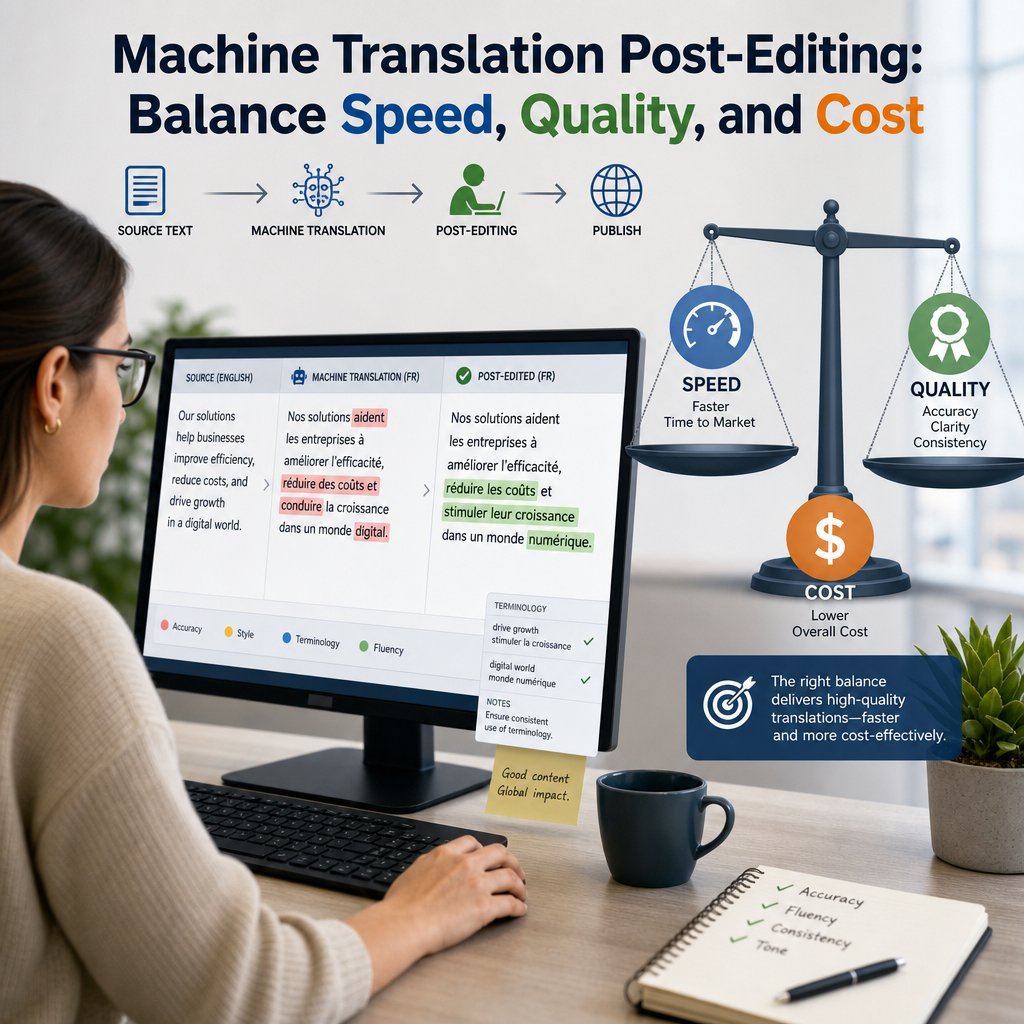
As global content volumes continue to grow, businesses face a familiar challenge: how to translate more material, into more languages, in less time, without compromising quality. Product catalogs expand overnight, knowledge bases evolve weekly, and marketing teams publish across multiple markets at once. In this environment, traditional translation workflows alone may not always be enough.
That is where Machine Translation Post-Editing (MTPE) comes in.
MTPE combines the speed of Machine Translation with the judgment, cultural awareness, and linguistic precision of professional human editors. Rather than choosing between fast but raw automated output and slower fully human translation, companies can use MTPE to achieve a smart balance between efficiency and quality.
For high-volume projects in particular, this approach can reduce costs, accelerate turnaround times, and still deliver dependable multilingual content. When supported by modern Neural Machine Translation (NMT) engines and translation memories, MTPE becomes a powerful solution for organizations that need to scale internationally with confidence.
What Is Machine Translation Post-Editing?
Machine Translation Post-Editing is the process of taking content produced by a machine translation engine and then having a trained linguist review, correct, and refine it.
The machine handles the first draft at speed. The human post-editor then steps in to improve:
- grammar and syntax
- terminology consistency
- meaning and accuracy
- style and readability
- cultural appropriateness
- formatting and compliance with brand guidelines
In simple terms, the machine does the heavy lifting, and the human ensures the result is fit for purpose.
This is very different from simply “running text through a translator tool” and publishing it as-is. Raw machine translation can be useful for getting the gist of a text, but client-facing or business-critical content often requires expert review before it can be safely used.
Why MTPE Matters More Than Ever
The rise of AI and NMT has transformed the translation industry. Modern machine translation systems are far more fluent than older rule-based or statistical systems. They can produce surprisingly strong drafts, especially for repetitive or structured content.
However, even advanced NMT still has limits.
Machine Translation can struggle with:
- industry-specific terminology
- ambiguous phrases
- brand voice
- cultural nuance
- idioms and figurative language
- context spread across multiple segments
- regulatory or legal precision
This is why Post-Editing remains essential. Human linguists understand what the machine cannot fully grasp: intent, tone, audience expectations, and subtle meaning.
MTPE is not about replacing people. It is about using technology intelligently to make human expertise more efficient.
How MTPE Works in Practice
A typical MTPE workflow includes several steps designed to maximize both speed and quality.
1. Content Assessment
Not every text is equally suited to MTPE. The first step is evaluating the material:
- What type of content is it?
- How repetitive is it?
- How important is style?
- How much risk is involved if a phrase is inaccurate?
- Is there existing terminology or translation memory available?
This helps determine whether MTPE is the right solution.
2. Machine Translation Draft
The source text is translated using an appropriate Neural Machine Translation engine. Depending on the project, the engine may be general-purpose or trained/customized for a domain.
3. Human Post-Editing
A professional linguist reviews the machine output and edits it based on the required quality level. This can range from light correction to full stylistic polishing.
4. Quality Assurance
The content may then go through QA checks for consistency, formatting, numbers, terminology, tags, and other technical elements.
5. Delivery and Reuse
Approved translations can be stored in translation memories, making future projects faster and more consistent. Over time, this creates a more efficient and cost-effective multilingual workflow.
Light vs. Full Post-Editing
Not all MTPE projects have the same objective. In general, there are two common levels of service.
Light Post-Editing
Light post-editing focuses on making the text understandable and accurate enough for practical use. The goal is not perfection, but usability.
This option is often suitable for:
- internal documentation
- customer support archives
- large knowledge bases
- user-generated content
- content meant for information rather than brand impact
With light post-editing, linguists typically correct major errors, mistranslations, omissions, and terminology issues, while leaving minor stylistic imperfections if they do not affect comprehension.
Full Post-Editing
Full post-editing aims for a result that reads much closer to human translation quality. The text is refined for style, clarity, consistency, and natural flow.
This is often the better choice for:
- customer-facing content
- product descriptions
- e-learning materials
- website pages
- business communications
- documentation requiring a polished finish
Choosing between light and full post-editing depends on your goals, audience, and budget.
When Clients Should Choose MTPE
MTPE is not the ideal solution for every project, but it is an excellent fit in many real-world scenarios.
High-Volume Content
If you need to translate thousands of product entries, support articles, or database-driven text, MTPE can dramatically reduce turnaround times.
For example, an e-commerce company launching in five new markets may need to translate:
- product titles
- descriptions
- specifications
- sizing information
- shipping FAQs
Fully human translation for this volume may take too long or exceed budget. MTPE offers a scalable alternative.
Tight Deadlines
When multilingual content must go live quickly, MTPE helps teams meet aggressive schedules without sacrificing essential quality control.
A software company releasing a new feature in multiple languages, for example, may use MTPE for release notes, interface help text, and support documentation.
Repetitive or Structured Content
Content with repeated phrases, patterns, or controlled language tends to work especially well with machine translation.
Examples include:
- technical manuals
- product catalogs
- standard operating procedures
- troubleshooting guides
- compliance documentation with repeated structures
Cost Optimization
MTPE can be a smart option for companies that want to reduce translation costs while maintaining a professional result. If quality expectations are clearly defined and the source content is suitable, MTPE often delivers strong value.
Ongoing Localization Programs
Organizations with continuous translation needs benefit from combining NMT, MTPE, and translation memories into one streamlined workflow. This improves consistency over time and supports faster updates across languages.
When MTPE May Not Be the Best Choice
Although MTPE is highly effective in many cases, some content still deserves full human translation from the start.
This often includes:
- highly creative marketing copy
- slogans and taglines
- luxury brand messaging
- sensitive legal contracts
- high-stakes medical content
- transcreation projects
- emotionally nuanced campaigns
In these cases, voice, persuasion, legal precision, or cultural impact may be too important to rely on a machine-generated draft.
The right language strategy is not about forcing one method onto every project. It is about matching the process to the content.
The Role of Neural Machine Translation and Translation Memories
One reason MTPE has become so valuable is the advancement of Neural Machine Translation. NMT systems analyze language in a far more sophisticated way than earlier generations of machine translation. The output is typically more natural, more context-aware, and more fluent.
But technology works best when it is part of a broader localization ecosystem.
Neural Machine Translation
NMT helps by:
- producing faster first drafts
- improving fluency
- handling large content volumes efficiently
- supporting multilingual expansion at scale
Translation Memories
Translation memories store previously approved translations so they can be reused in future projects. This offers several benefits:
- better consistency across projects
- lower costs over time
- faster updates for recurring content
- alignment with established terminology and brand preferences
When NMT and translation memories are used together, post-editors can work more efficiently and focus attention where it matters most.
For clients, this means a smarter workflow, not just a faster one.
Common Misconceptions About MTPE
Despite its growing popularity, MTPE is still sometimes misunderstood.
“Machine Translation is enough on its own.”
Raw machine output may look fluent, but fluency does not guarantee accuracy. A sentence can sound natural while still being misleading, incomplete, or contextually wrong.
“Post-editing is just quick proofreading.”
Professional post-editing involves much more than spotting typos. Linguists assess meaning, terminology, consistency, tone, and suitability for the target audience.
“MTPE always means lower quality.”
Not true. When used appropriately, MTPE can produce excellent results. The key is selecting the right content, the right workflow, and experienced post-editors.
“MTPE is only for low-budget projects.”
In reality, many sophisticated global companies use MTPE strategically. It is not merely a budget option; it is often the most practical approach for scaling multilingual content intelligently.
What Quality in MTPE Really Means
Quality should always be evaluated according to purpose.
A translated internal memo does not need the same level of stylistic refinement as a homepage headline. A support article does not need the same creative polish as a brand campaign. Good localization providers help clients define the right quality target for each content type.
In MTPE, quality means:
- the message is correct
- the terminology is appropriate
- the content is clear and natural enough for its intended use
- the text aligns with brand and domain requirements
- the workflow supports speed without creating risk
This practical, purpose-driven view is what makes MTPE so valuable.
A Practical Example
Imagine a manufacturer expanding into several European and Asian markets. The company needs to translate:
- 20,000 product descriptions
- installation instructions
- safety information
- FAQ content
- support documentation
Some of this content is repetitive and terminology-heavy. Much of it must be launched quickly.
A full human-only workflow may be too slow and expensive at this scale. A raw machine-only workflow would introduce too much risk, especially for safety content and technical accuracy.
An MTPE workflow, supported by NMT and translation memories, offers a strong middle ground:
- machine translation accelerates the first draft
- post-editors correct terminology and meaning
- translation memories ensure consistency
- QA protects technical integrity
- delivery times improve significantly
The result is a localization process that is both scalable and reliable.
Why the Right Language Partner Matters
Successful MTPE depends on more than technology alone. It also requires sound project management, skilled linguists, clear quality standards, and the right toolset.
A knowledgeable localization partner will know how to:
- assess content suitability for MTPE
- select the best NMT workflow
- apply terminology and style guides
- leverage translation memories effectively
- match the editing level to business goals
- maintain consistency across languages and projects
This is where a tech-savvy provider can create real value. By combining advanced tools with human expertise, companies can move faster without losing control over quality.
For businesses managing complex multilingual content, this is no longer a luxury. It is a competitive advantage.
Conclusion
Machine Translation Post-Editing offers the best of both worlds: the speed of AI-driven Machine Translation and the precision of human linguistic review. For high-volume, repetitive, or time-sensitive content, it can cut costs, accelerate delivery, and maintain the quality businesses need to communicate effectively across markets.
The key is knowing when to use it, how to define the right quality level, and how to integrate technologies like Neural Machine Translation and translation memories into a well-managed workflow.
When done right, Post-Editing is not a compromise. It is a strategic localization solution that helps organizations scale smarter, faster, and with confidence.