





Multilingual SEO: The Golden Tool for Global Digital Growth
Did you know that speaking your customer’s language is one of the most powerful Search Engine Optimization (SEO) strategies worldwide? In a hyper-connected digital landscape, expanding a business beyond domestic borders requires much more than simply shipping products internationally or accepting foreign currencies. True global digital growth relies on visibility.
For modern businesses, localizing and translating websites is no longer a luxury reserved for massive enterprise corporations; it is a fundamental driver for increasing organic traffic and opening sales channels in new, lucrative international markets. Today’s global consumer expects a frictionless, culturally relevant digital experience tailored specifically to their regional norms and native language.
When you align your brand with the linguistic and cultural realities of your target audience, you multiply your website’s chances of appearing at the top of search engine results. This article breaks down exactly how smart keyword translation, adapting to foreign user search intent, and specialized multilingual optimization act as the ultimate golden tools for scaling your business globally.
The Difference Between Standard Translation and Multilingual SEO
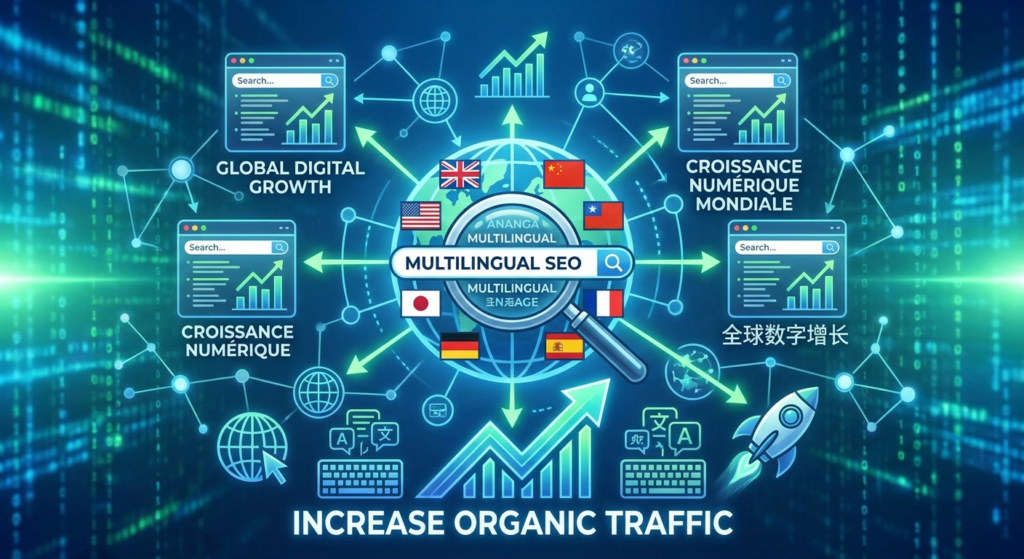
To truly grasp the power of Multilingual SEO, one must understand that standard translation and SEO localization are two entirely entirely distinct processes. Standard translation involves converting words from one language to another while maintaining the original meaning. While this is sufficient for instruction manuals or internal documents, it falls woefully short when applied to digital marketing and web visibility.
Multilingual SEO, on the other hand, is a multi-layered, strategic process. It combines high-quality linguistic translation with complex search engine algorithms and user intent analysis. It involves dissecting the distinct ways a foreign audience searches for a product or service online, selecting the exact keywords they use (which are rarely direct translations), and optimizing the website’s technical backend to communicate clearly with international search engines like Google, Bing, Baidu, or Yandex.
If you solely rely on direct translation, your website might make grammatical sense, but it will be practically invisible to search engines. Multilingual SEO bridges the gap between readable content and highly discoverable content.
The Core Pillars of Global Search Optimization
Achieving dominance in foreign search engine results requires mastering several foundational elements of international SEO. Simply translating your English landing pages into Spanish, French, or Japanese won’t drive traffic unless these specific pillars are carefully addressed.
1. Smart Keyword Translation and Transcreation
One of the most dangerous traps in international digital marketing is the direct translation of keywords. Languages are inherently complex, and search habits are deeply rooted in local culture, slang, and vernacular.
For example, an American company selling “sweaters” might translate their main keyword directly into British English, expecting high search volumes. However, British consumers search overwhelmingly for “jumpers.” In Spanish, a literal translation of “car insurance” might yield “seguro de carro,” which works perfectly in Latin America but will miss a massive segment of searchers in Spain, who instead search for “seguro de coche.”
Smart keyword translation—often referred to as transcreation—requires local market research. Instead of translating a successful English keyword list, SEO specialists must identify the seed topic and uncover the high-volume, low-competition keywords actually utilized by the target audience in that specific locale.
2. Catering to the Foreign User’s Search Intent
Search intent—the underlying goal a user has when typing a query into a search engine—varies wildly from culture to culture. Google’s algorithms are highly adept at identifying exactly what a user wants to achieve, whether it is informational, navigational, commercial, or transactional.
A marketing campaign that works perfectly for a commercial intent keyword in North America might require a more informational approach in a German or Japanese market, where consumers historically require detailed technical specifications, reviews, and trust signals before making a purchasing decision.
Multilingual SEO focuses heavily on matching the translated and localized content to the foreign user’s search intent. By providing precisely what the localized user expects to see, businesses reduce bounce rates, increase time-on-page, and send strong positive ranking signals back to international search algorithms.
3. Mastering Technical Multilingual SEO Foundations
Your linguistic efforts must be backed by a flawless technical infrastructure. Search engines need precise, code-level indicators to understand which language and regional version of your website to serve to a specific user.
- Hreflang Tags: This hidden piece of HTML code acts as a map for search engine crawlers. It explicitly states the language of the page and the geographical region it targets, ensuring that a French-speaking user in Canada is directed to the
fr-caversion of your site, rather than thefr-frversion meant for users in France. - Site Architecture: Choosing the right URL structure (such as Country Code Top-Level Domains like
.deor.uk, sub-directories likedomain.com/de/, or sub-domains likede.domain.com) plays a crucial role in how search engine authority is established in different regions. - Server Speed and Local Hosting: International audiences require fast loading times just as much as your domestic audience. Multilingual SEO also factors in Content Delivery Networks (CDNs) to ensure global users enjoy a frictionless, high-speed experience.
Why Speaking Your Customer’s Native Language Drives Conversions
Organic search traffic is useless if it does not convert into tangible sales or qualified leads. The ultimate goal of capturing international traffic is revenue generation, and nothing drives digital conversions better than linguistic comfort.
Research repeatedly shows that a vast majority of global consumers strongly prefer to make online purchases in their native language. Furthermore, a large segment of shoppers will actively avoid websites that are only available in a foreign language, regardless of how attractive the product or price might be.
When you provide a native-language experience, you inherently build trust. It signals to the consumer that you value their specific market and understand their cultural context. Localization removes friction from the buying journey. When navigation menus, checkout carts, privacy policies, and customer support pages are flawlessly localized, users feel secure entering their payment details and completing a transaction.
The Pitfalls of Basic Machine Translation
With the rise of Artificial Intelligence and readily available machine translation plugins, many businesses mistakenly believe that full automation is the key to global scaling. This is an assumption that can deeply harm your brand’s digital reputation and SEO standing.
Basic translation plugins often create “thin content” or grammatically awkward phrasing that damages user experience. Worse, automated plugins usually strip away all strategic SEO value. They do not know which localized keywords have the highest search volumes. They cannot format Meta Titles and Meta Descriptions to optimal lengths to avoid truncation on search engine results pages. They lack the cultural nuance to avoid inadvertently offensive idioms.
Furthermore, search engines prioritize high-quality, helpful content. Clunky, automatically generated translations result in high bounce rates. As users repeatedly land on your website and instantly click the “back” button due to poor readability, search engines register your site as low-quality, driving your rankings down not just in the foreign market, but potentially globally.
The Cube Localization Advantage: Precision, Nuance, and Results
This is exactly where the specialized expertise of Cube Localization shines. Securing top-tier search visibility in a crowded global marketplace requires a partner who understands that language and algorithms are completely intertwined.
At Cube Localization, we do not just translate your website; we provide comprehensive localization services fully compliant with complex international search engine standards. Our methodology effectively marries expert linguistics with data-driven SEO tactics, yielding measurable, long-term digital growth.
In-Depth Target Market Analysis
Before a single word is translated, our team analyzes your target market. We map out the digital landscape, identifying exactly who your foreign competitors are and the specific SEO strategies they utilize to capture traffic. This lays the groundwork for an intelligent entry strategy tailored for impact.
Specialized Keyword Translation and Optimization
We abandon literal translation in favor of deep keyword research in the target language. By analyzing search volumes, competition levels, and user search intent within the new market, we formulate a powerful localized keyword glossary. This ensures that your website doesn’t just speak to the audience in their native language, but actively attracts them through the exact phrasing they type into Google.
Elevating the Algorithm While Engaging the Reader
Our primary philosophy is that great SEO localization serves two masters: the global search algorithms that index your site, and the human being who ultimately opens their wallet.
- For the Algorithm: We optimize critical on-page SEO elements including URLs, Header Tags (H1s, H2s), Alt Text for images, Meta descriptions, and title tags using strategically researched international keywords.
- For the Human User: We leverage highly skilled, native-speaking localization experts who adapt the tone, cultural nuances, format, and phrasing of your brand’s voice. This results in content that flows naturally, building authority, engagement, and trust.
By fusing these two critical elements, Cube Localization ensures that your brand doesn’t merely exist on the international web—it dominates the competition.
Conclusion
Scaling a business globally is a massive undertaking, but capturing organic digital real estate should be the centerpiece of that strategy. Multilingual SEO is not a fleeting trend; it is the definitive golden tool for unlocking vast pools of un-tapped international traffic, establishing cross-border brand authority, and building robust global sales channels.
Catering to the linguistic preferences and distinct search intent of a foreign audience elevates your website from a simple digital brochure to an active global sales engine. With the specialized, standard-compliant localization services provided by Cube Localization, your business gains a competitive edge in every language. Equip your brand with the power of native-speaking digital expertise, and watch your global footprint grow.